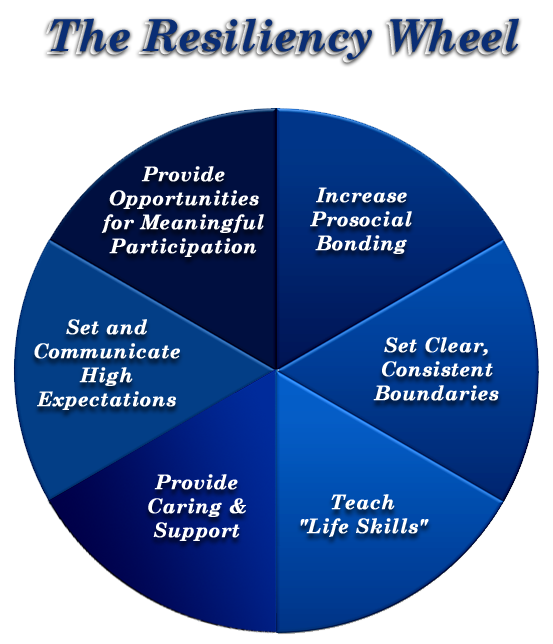
 by Nan Henderson, M.S.W., Ph.D.


I developed this quiz for anyone—teens, adults, elders—to assess and strengthen the resiliency building conditions in their lives. Use it for yourself or use it as a tool to help others you care about build their resiliency.
PART ONE:
Do you have the conditions in your life that research shows help people to be resilient?
People bounce back from tragedy, trauma, risks, and stress by having the following “protective” conditions in their lives. The more times you answer yes (below), the greater the chances you can bounce back from your life’s problems “with more power and more smarts.” And doing that is a sure way to increase self-esteem.
Answer yes or no to the following. Celebrate your “yes” answers and decide how you can change your “no” answers to “yes.” (You can also answer “sometimes” if that is more accurate than just “yes” or “no”.)
1. Caring and Support
______I have several people in my life who give me unconditional love, nonjudgmental
listening, and who I know are “there for me.”
______I am involved in a school, work, faith, or other group where I feel cared for and valued.
______I treat myself with kindness and compassion, and take time to nurture myself
(including eating right and getting enough sleep and exercise).
2. High Expectations for Success
______I have several people in my life who let me know they believe in my ability to succeed.
______I get the message “You can succeed,” at my work or school.
______I believe in myself most of the time, and generally give myself positive
messages about my ability to accomplish my goals–even when I encounter difficulties.
3. Opportunities for Meaningful Participation
______My voice (opinion) and choice (what I want) is heard and valued in my
close personal relationships.
______My opinions and ideas are listened to and respected at my work or school.
______I volunteer to help others or a cause in my community, faith organization, or school.
4. Positive Bonds
______I am involved in one or more positive after-work or after-school hobbies or activities.
______I participate in one or more groups (such as a club, faith community, or
sports team) outside of work or school.
______I feel “close to” most people at my work or school.
5. Clear and Consistent Boundaries
______Most of my relationships with friends and family members have clear,
healthy boundaries (which include mutual respect, personal autonomy,
and each person in the relationship both giving and receiving).
______I experience clear, consistent expectations and rules at my work or in my school.
______I set and maintain healthy boundaries for myself by standing up for myself,
not letting others take advantage of me, and saying “no” when I need to.
6. Life Skills
______I have (and use) good listening, honest communication, and healthy conflict resolution skills.
______I have the training and skills I need to do my job well, or all the skills I
need to do well in school.
______I know how to set a goal and take the steps to achieve it.
PART TWO:
People also successfully overcome life difficulties by drawing upon internal qualities that research has shown are particularly helpful when encountering a crisis, major stressor, or trauma.
The following list can be thought of as a “personal resiliency builder” menu. No one has everything on this list. When “the going gets tough” you probably have three or four of these qualities that you use most naturally and most often.
It is helpful to know which are your primary resiliency builders; how have you used them in the past; and how can you use them to overcome the present challenges in your life.
You can also decide to add one or two of these to your “resiliency-builder” menu, if you think they would be useful for you.
PERSONAL RESILIENCY BUILDERS
(Individual Qualities that Facilitate Resiliency)
Put a + by the top three or four resiliency builders you use most often. Ask yourself how you have used these in the past or currently use them. Think of how you can best apply these resiliency builders to current life problems, crises, or stressors.
(Optional) You can then put a by one or two resiliency builders you think you should add to your personal repertoire.
Relationships — Sociability/ability to be a friend/ability to form positive relationships
Service – Giving of yourself to help other people; animals; organizations; and/or social causes
Humor — Having and using a good sense of humor
Inner Direction — Basing choices/decisions on internal evaluation (internal locus of control)
Perceptiveness — Insightful understanding of people and situations
Independence — “Adaptive” distancing from unhealthy people and situations/autonomy
Positive View of Personal Future – Optimism; expecting a positive future
Flexibility — Can adjust to change; can bend as necessary to positively cope with situations
Love of Learning — Capacity for and connection to learning
Self-motivation — Internal initiative and positive motivation from within
Competence — Being “good at something”/personal competence
Self-Worth — Feelings of self-worth and self-confidence
Spirituality — Personal faith in something greater
Perseverance — Keeping on despite difficulty; doesn’t give up
Creativity — Expressing yourself through artistic endeavor, or through other means of creativity
You Can Best Help Yourself or Someone Else Be More Resilient by…
1. Communicating the Resiliency Attitude: “What is right with you is more powerful than anything wrong with you.”
2. Focusing on the person’s strengths more than problems and weaknesses, and asking “How can these strengths be used to overcome problems?” One way to do this is to help yourself or another identify and best utilize top personal resiliency builders listed in The Resiliency Quiz Part Two.
3. Providing for yourself or another the conditions listed in The Resiliency Quiz Part One.
4. Having patience…successfully bouncing back from a significant trauma or crisis takes time.
| Please share this article -> |    |


